
If your boiler keeps losing pressure, the gauge is bouncing about like it’s possessed, or you’re forever topping up the filling loop… the expansion vessel is one of the first things to suspect.
- What is an expansion vessel (and why does it matter)?
- Boiler expansion vessel replacement cost in the UK
- What affects the cost?
- Can an expansion vessel be repaired instead of replaced?
- Signs your expansion vessel is failing
- Quick DIY checks (safe and simple)
- How long does expansion vessel replacement take?
- Is it worth replacing the expansion vessel or getting a new boiler?
- Can I replace an expansion vessel myself?
- How to keep your expansion vessel healthy
The good news? It’s often fixable - and even when it does need replacing, it’s usually not as expensive as you’d think (unless your boiler’s been wedged into a cupboard designed for a toaster).
In this guide, we’ll break down typical UK costs, what can bump the price up, the tell-tale signs your vessel is on the way out, and whether it’s smarter to repair the boiler or replace it.
🔑 Key takeaways:
Typical expansion vessel replacement cost: £180–£450 (parts + labour), depending on boiler and access.
If it’s an external/add-on vessel: often £180–£350 (usually easier).
If it’s internal and awkward: commonly £250–£450+.
Sometimes it doesn’t need replacing - it might just need recharging (often cheaper).
If your boiler is older and stacking faults, it can be smarter to put the money toward a new boiler.
What is an expansion vessel (and why does it matter)?
A boiler expansion vessel is a small tank (usually red or grey) designed to manage pressure in your heating system.
When water heats up, it expands - and without somewhere for that extra volume to go, pressure would shoot up fast.
Inside the vessel is a flexible rubber diaphragm that separates:
Heating water on one side
Air (or nitrogen) on the other
That air side acts like a cushion. If the diaphragm fails or the vessel loses its charge, your system can’t absorb the pressure changes properly - so you’ll often see wild pressure swings, and sometimes water dumping out of the pressure relief valve (PRV).
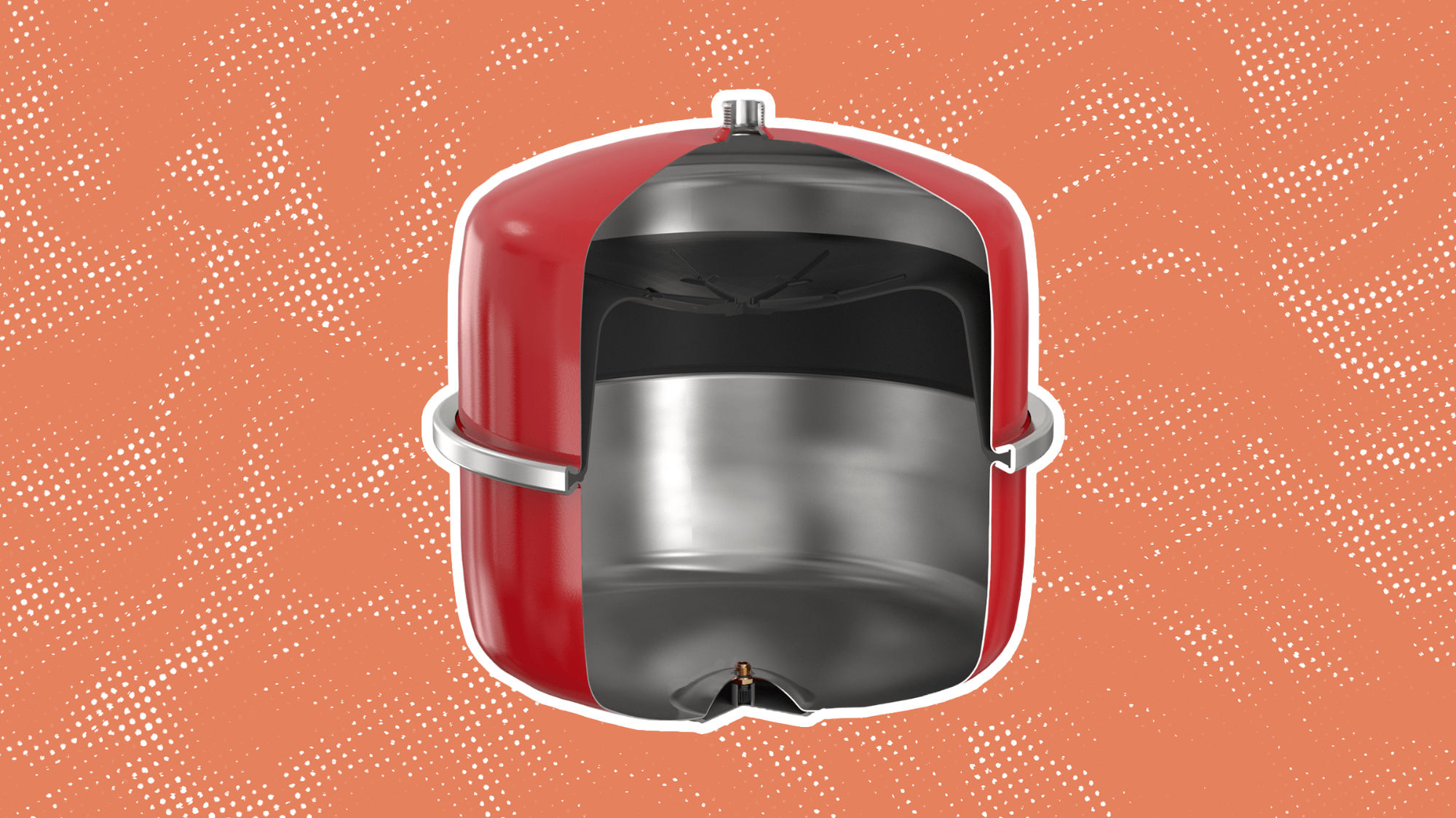
Image of a standard expansion vessel / Heatable
Boiler expansion vessel replacement cost in the UK
In the UK, an expansion vessel replacement typically costs £180–£450 including parts and labour, but it can rise to £600+ if the boiler is difficult to strip down or parts are pricier.
£180–£350: straightforward replacement, good access
£250–£450: internal vessel, more time to access
£450–£600+: premium parts, complex installs, or additional faults
Typical breakdown:
Vessel part: £40–£160
Labour: £120–£300+
The reason prices vary is simple: on some boilers it’s a quick swap - on others it’s a mini rebuild just to reach the part.
If you want, I can also turn this into a neat pricing table (Recharge vs External vs Internal) which tends to perform really well for featured snippets.
What affects the cost?
A few things decide whether this is a quick, fairly cheap job… or one that creeps up.
[1] Internal vs external vessel
Internal vessel (inside the boiler): more strip-down time = higher labour costs
External/add-on vessel: usually easier access, so it’s often cheaper overall
[2] Boiler make and model
Some boilers use vessels that are:
more expensive
harder to source
or simply more fiddly to fit (hello, extra labour)
[3] Access (the silent budget killer)
If your boiler is:
boxed in
wedged into a tight cupboard
installed too close to panels
or generally a “who fitted this?” situation
…expect labour costs to rise because the engineer needs more time just to get to the part.
[4] Whether other parts need replacing too
Expansion vessel problems can cause - or be mistaken for - issues like:
PRV (pressure relief valve) discharge (often shows as dripping outside)
filling loop faults
leaks on the heating circuit
a blocked condensate (can mimic other boiler symptoms)
a failed heat exchanger (rare, but pricey)
If the PRV has been dumping water for a while, engineers often recommend replacing the PRV at the same time.
Can an expansion vessel be repaired instead of replaced?
Yep - sometimes it just needs a recharge, not a full replacement.
Option A: Vessel recharge (try this first)
If the diaphragm is intact, the vessel can lose its air cushion over time.
Typical cost: £80–£180
Engineers usually:
isolate the boiler and drop system pressure
recharge the vessel with a gauge/pump
repressurise and test for stable pressure
Option B: Vessel replacement
If it won’t hold pressure, is leaking, or the diaphragm has failed, it’s replacement time.
Signs your expansion vessel is failing
If you’re seeing any of the below, the expansion vessel jumps right up the suspect list.
Pressure shoots up when the heating’s on (e.g. 1.2 bar → 2.8 bar)
Then drops back down once it cools (sometimes to near zero)
The PRV outlet pipe outside is dripping - especially after a heating cycle
You’re repressurising the system regularly (every few days / every week)
You keep getting air in the radiators (cold at the top) and you’re also losing pressure
Pressure climbs fast even after a short burst of heating
Top tip: A small rise in pressure when the system heats is normal. Big jumps toward 3 bar (often followed by water dumping outside) aren’t.
Quick DIY checks (safe and simple)
A couple of quick checks can help you narrow down what’s happening - no gas work, no dismantling.
[1] Check the PRV outlet pipe (outside)
Most boilers have a copper pipe that exits the wall (often near the boiler) - this is the pressure relief valve (PRV) discharge.
Have a look after the heating’s been running. If the pipe is:
constantly dripping, or
wet/damp after a heating cycle
…that usually points to a pressure problem - commonly the expansion vessel (and sometimes the PRV itself).
[2] Watch the pressure gauge during a heating cycle
Check the gauge when the system is cold, then again once the heating has been on for a bit.
Cold pressure: typically 1.0–1.5 bar
Hot pressure: should rise slightly, but shouldn’t go wild (often stays under ~2.0 bar)
If it shoots up toward 3 bar and you then notice water dumping from the PRV pipe, the expansion vessel is a very strong suspect.
How long does expansion vessel replacement take?
Most expansion vessel jobs are around 1–3 hours, depending on what’s fitted and how easy it is to reach.
External/add-on vessel: often quicker
Internal vessel (inside the boiler): can take longer due to strip-down time
If your boiler is boxed in or wedged into a tight cupboard, it can take longer - and labour costs usually rise with it.
Is it worth replacing the expansion vessel or getting a new boiler?
Here’s the simple rule of thumb: fix it when it’s a one-off, replace the boiler when it’s one fault of many.
Replace the vessel if:
The boiler is generally reliable and you’re not constantly repairing it
It’s under ~8–10 years old
The repair quote is sensible (roughly under ~£350–£450)
There are no other major faults showing up (PCB, fan, heat exchanger, etc.)
Consider replacing the boiler if:
It’s 12+ years old
You’ve had multiple repairs recently (it’s becoming a hobby you didn’t ask for)
It needs a vessel plus other pricey parts (PCB, fan, heat exchanger, diverter valve, etc.)
You’re paying for repeated call-outs and the boiler still isn’t behaving
A repair can be smart - but you don’t want to keep feeding money into a boiler that’s clearly on borrowed time.
Can I replace an expansion vessel myself?
Boiler internals in the UK come with real risk: pressurised water, electrics, leaks, and components that sit uncomfortably close to gas-related parts.
Practical answer:
An external/add-on vessel on the heating circuit might be DIY-able for experienced, competent people
An internal expansion vessel (inside the boiler casing) should be handled by a qualified engineer
If you’re not 100% confident, don’t chance it - a bad install can cause leaks, pressure problems, or damage to the boiler.
How to keep your expansion vessel healthy
You can’t make it last forever, but you can reduce the odds of pressure chaos:
Get an annual boiler service (pressure and PRV checks are usually part of this)
Don’t keep repressurising the system without fixing the underlying issue
Fix small leaks early - constant topping up adds oxygen to the system, which speeds up corrosion
If the system is dirty or sludgy, consider a system clean + inhibitor to protect components long-term.
Get A New Boiler Quote Today
If you’re aiming to get the best deal on a new boiler, consider getting your boiler installation with us. Here’s why:
Gas Safe installation within 24 hours.
Thousands of satisfied customers with an average score of 4.9 on Trustpilot, surpassing the market leader.
Which? Trusted Trader: Heatable is proudly recognised as a Which? Trusted Trader.
Price match guarantee: We will match any like-for-like cheaper quote.
Flexible payment options, including interest-free finance*.
Up to a 12-year guarantee on selected boilers.
Fixed price guarantee: No hidden costs.
Save your quote and decide later.
Get an instant fixed price on a new boiler here.
To learn more about boilers, visit our advice section, check out our YouTube channel, or read customer testimonials here.